Friday, November 08, 2013

Where the grass is always greener

Rain. We give it a bad rap. Wet and splodgy, irritating with its inescapable shroud of damp. An unwanted present from a dreary sky, sent to make boots muddy and ruin plans best laid. A shocking contrast from the sun in Spain that was 20 degrees warmer. But then surely rain is what puts the Great in Britain, our reassuring companion, along with tea and cake.

It is fair to assume that Basingstoke and rain are hardly the most riveting bedfellows, but shops are shops and people are still wearing shorts to go to Tesco. It is hard to let go of the summer and, just for a moment, it returns on a Sunday afternoon at The Vyne. Here, amongst the moist muddy tracks are the autumnal fruits of summer – fungi cascading down mossy brown trunks, spiky green pods spilling out with chestnuts, leaves wafting down onto the ground, coating the forest floor in a layer of browns and yellows. All helped by that cursed rain.


Rain is no stranger to the southwest of England, as Atlantic fronts begin to form; waiting in the wings to blow in on winds, some strong enough to bring down trees. This is the season where a night can be dramatic, and the next day as placid as a hippy doing yoga on a fluffy white marshmallow. Air blows in clean and fresh and the lowering sun in the southern sky illuminates the greens-turning-brown on magical days.

Magical days are easy to come by in St Agnes, sitting tucked in on the north coast of Cornwall; a prized position to make most of the sun, and the rain, and that wind when it blows on in. Like so many Cornish towns it totters down through a maze of narrow streets to a beach; there are a few pokey shops and – it turns out – a blessed bakery serving the type of sausage rolls I have craved in my mind since seeing one snatched away for someone else’s consumption last year in Hobart. Proper good sausage rolls that are hard to come by in Greggs and Warrens and anywhere in Australia other than one place in Hobart. Possibly.


Unlike more genteel parts of Cornwall, the landscape here has a raggedy rugged edge to it, peppered with tin mining relics, tinged with a faded glory scoured by eternal weather. The coast path is solid and spectacular, as it always is, heading along to St Agnes Head with views north to Trevose and south along a wave pounded coast towards St Ives. Higher up – atop St Agnes Beacon – an even mightier panorama unfolds, with most of West Cornwall on view, and St Agnes nestled down below, reached by muddy field to complete a memorable circular.


Magical days are harder to come by holed up in Plymouth library trying to make something up that is of a work-related nature and popping out for mediocre coffee in the hope that just for once it may not be mediocre. Even mediocre coffee can be a welcome distraction though, so when the cloud clears and a sunny afternoon pops up out of the blue the allure to escape is palpable. Luckily there is a very quick escape from the varied charms of Plymouth, by taking a bobbling boat across the Tamar to Mount Edgcumbe

Here, the meander of autumnal woodlands and fading gardens give way to exposed hilltops, looming high over the Tamar with views spreading out to encompass a Cornish and Devonian sea.  Inland the wide river flows into a border landscape of patchwork fields and secret inlets, punctuated by towns and villages and giving out to rising moorland hills. Herds of deer scarper into nearby woods, aware of your presence and no doubt cognisant of the fact that you would quite like to see some good old fashioned autumnal rutting. Instead, the view will suffice.


Plonked amongst this idyll is the city of Plymouth, with rows of houses running like dominoes over the lumpy contours of the suburbs, meeting cranes and boats toppling into the river. Its waterfront welcome mat is striking with the Where’s Wally striped beacon of Smeaton’s Tower and a wheel that looks even bigger from afar. Illuminated is a background of moorland, sweeping over the horizon. It is here that you can appreciate the quite blessed setting in which Plymouth sits. Yeah, the city might be a bit crummy and tatty in places, but a turnip growing in a field of flowers is better than a turnip growing in a pile of shit, right?

Another philosophical conclusion I have come up with over the last few weeks is, when situated in this part of the world, even when the day is crap, you are having a stinker, work sucks, and other such things, there is the consolation of easy access to clotted cream, jam, scones and tea. This can make a bad day amazing. At Mount Edgcumbe it made a good afternoon sublime.

The hills behind Plymouth spread afar into Dartmoor National Park and this represented what was to become my final outing into the virtual field of flowers surrounding the city. A circular walk from Yelverton offered a perfectly balanced English country composition of riverside woodlands, sheep and cow fields, tumbledown cottages and exposed tors. This amble on the fringe of Plymouth was a pretty decent way to bid it all farewell.


Spending time here, intermittently from August to November, has obviously allowed me to observe the changing seasons take effect. What once was an uninterrupted blanket of flourishing green is now softening, holes are appearing, and things are shrivelling. A golden brown is slowly but inevitably creeping into the landscape and soon even this will become more spartan and altogether less comforting.


And as the leaves disappear from the trees my southward migration kicks in. It has become a customary route over the last seven years, this time a little later after a little longer than normal. It leaves me with mixed feelings; sad to be leaving one place and excited to be heading to the other. It’s a feeling that comes to life when marvelling in the grand autumnal splendour of Mount Edgcumbe only to come across a couple of Eucalyptus trees shooting up into clear blue sky, aliens in a foreign land. For a moment I am transported, wrapped up against a southwest autumn and looking up at the promise of Australia. The best of both worlds, where leaves do not fall and a cream tea is just around the corner.

Thursday, October 10, 2013

Hola amigos!

Wary that I may just drift into the comforts of life again in Plymouth and conscious of impending Halloween-related mania, I took a couple of weeks out of this (only slightly) working holiday. The first part involved meeting up and hanging out with friends once more, following which a trip overseas provided some peace and quiet and strangely rare solo time.

A whistle-stop visit to London offered another chance to reacquaint myself with old hang outs and deep connections. Now with young ones to entertain this principally involves visits to the parks of North London, typically on a rota system. It was pleasing to add a different park to the list, within the tranquil leafiness of Highgate Wood. The extra bonus here was that once slides and nets and steps and bars had been exhausted, a little lodge served up fine food to eat al fresco in the sunshine. Similarly, while by no means a new addition, Golders Hill Park delivered gelato to cool down on an astonishingly warm and sheltered park bench the next day.
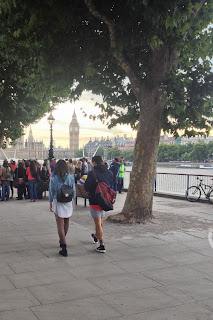
London is quite a different place when you visit and are not subjected to a long daily commute for tedious work and returning home for a late dinner mired in tiredness. Indeed, I was quite happy to take an hour long bus journey, absorbing the sites on the top deck of the number 13 bus from Golders Green: Finchley Road, Swiss Cottage, Lords Cricket Ground, Regents Park, Baker Street, Oxford Street and, my stop, Piccadilly Circus. I was equally content to mill around to Covent Garden and Embankment and cross over to the South Bank for a little, killing time until a get-together in Clapham. I know for sure now that I am officially at a different stage in life to when I was living in London:  waiting for a friend in a pub reading a paper and struggling to block my ears to the awful music that was far too loud. Confirmation of this comes through reminiscing on the tube home with two friends from university who I met half of my lifetime ago.  But this is nothing to despair at.

More old friendships, albeit only for about one third of my lifetime, were enjoyed during a few days in Lytham up in the good old northwest of England near Blackpool. The weather for the first couple of days was better than when I visited in August, allowing opportunity to amble the prom and still try and figure out why so many people come here for their holidays. By midweek it was more typically grey with some rain and a few fleeting rays of sun. This coincided with my birthday, which was further official confirmation that I am of an older generation. Still, in Lytham such is the populace of wrinklies that I generally still feel quite young, and can do impetuous youthful things like play GTA V and watch the end of Breaking Bad like everyone else in the world during this period in history.
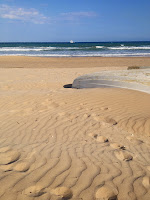
It was a grey, drizzly day leaving Lytham and I am very conscious that I will be in England when the calendar turns to November (or Jungfrau). With this in mind, and another way in which I can make myself feel young, I boarded a plane to Spain. Costa Blanca, Quesada, Dona Pepa Pig and a home from home from home sadly less visited. This was an opportunity to wear shorts again, to think a bit more like I was in Australia, albeit with worse coffee and inferior beaches and not as much untainted open space. It was also rather nice to have some time to myself – the first in quite a long time really.

I probably would have gone a bit stir-crazy if it wasn’t for the company of a mouse in the house and a hire car to get around. And so, a few excursions (without the mouse) took in mountain towns and humid clouds, coastal resorts and big rocks, and lovely fragrant forests and views.

The first trip out took me to a few Spanish mountain towns, all with higgledy piggledy streets and churches and squares. At Biar, a medieval castle looks out from the highest point perched upon a lump of rock. A fee of one Euro allows you entrance to the tower where you can get the slowest ever English commentary and walk three flights of stairs to the top. Overlooking the charming little town and fields and hills of rustic terraces, it’s one of the nicer spots in this area.


Down the road from here, Bocairent did not feature prominently in any of the guide books I had to hand. Mind you, a lot of this material seems out-of-date as roads have changed names or gone missing altogether. Still, I vaguely recall reading something on an airplane in Australia about this place, so it was worth a stop out of curiosity if nothing else. I gather there are lots of little caves around and, while it took a little finding, the old town was very much in the classic Spanish hillside variety.
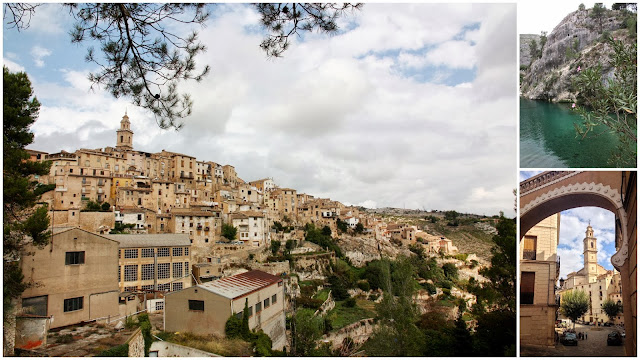

From here I missed my intended turn off the main road but this was one of those fortunate mistakes. The next five kilometres or so, towards Ontinyent, thread through a wonderful limestone gorge, a great road to drive on and a worthwhile stop at some pools of blue called El Pou Clar. They would have sparkled like sapphires in the sun only the sun was getting less and less frequent. In fact, the remainder of the day was blighted by low cloud and a touch of rain on the drive back to Quesada, via Alcoy and Agost.

It was a much sunnier start on the second day out, which infuriatingly darkened some 100 kilometres further north around Calpe. Calpe appears to be a typical Costa resort, with a few high rise hotels, a promenade, clusters of apartments and alright kind of beaches. What sets it apart is a huge lump of rock which juts out into the sea at its northern end. It’s called the Penon De Ifach and it turns out you can climb the thing.

The climb is actually a lot easier than you might think looking at the precipitous lump from the bottom. There’s a bit of a tunnel to go through and some fairly consistent scrambling near the top, but apart from that I have to say it made a nice change to find somewhere in this part of Spain where you could actually go for a decent walk in natural surroundings. The very top though is undoubtedly Spanish, with rocks being daubed in graffiti and feral cats pestering and lending a not-so-lovely aroma to the scene. The views of course though are what make it so worthwhile, especially when the sun makes an appearance.


Despite darkness clinging to the tops of the mountainous interior I left Calpe and headed inland along the Guadalest Valley for the afternoon. Guadalest itself, sheltered by the highest peaks of the Sierra Aitana, remained dry and warm and at times sunny. Certainly warm enough for an ice cream, the Crema Catalana being of particularly fine quality.

Beyond Guadalest the winding roads empty and there is a great deal of scenery lurking under the clouds. What I find infuriating about this though is that there is rarely a place to stop, a viewpoint, a path, a forest, a trail. A lot of the land looks untouched and empty, barren and wild. Who owns it and looks after it I do not know. It just seems to be there, an intangible expanse of rocky scrub and forest.

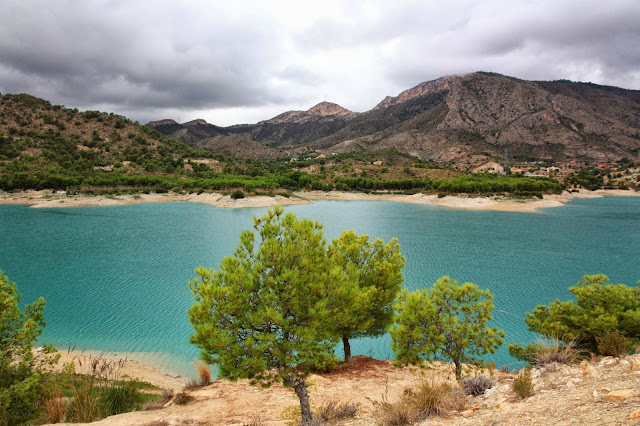
It was not until I was back closer to the coast near Villajoyosa that some of the scenery could be accessed, albeit a man-made manifestation at the Embalse de Amadorio. The water colour of these reservoirs is always something to behold. It seems they are of significant allure to locals too, who come here to get amorous and leave cans of energy drink, tissues and empty durex boxes scattered around the car park. Maybe I blame locals too quickly, given we’re not actually too far from Benidorm.

Pleasingly my final significant trip out managed to bring me to some rare Spanish coastal wilderness and a decent trail leading to a fine viewpoint. It’s the kind of set up you begin to take for granted in Australia or, with its amazing coast path, the southwest of England. Over the hills from the strip of concrete that is La Manga and between here and the port of Cartagena, a small pocket of rugged coastline and fragrant forest testifies to what this area once was like. This is known as Monte de las Cenizas and one of the best things about it is that the park authorities have closed the gravel road up to this lookout. This means it is little visited, little defaced and there is a good three kilometre trail with only a gentle gradient to overcome. And at the end, a reward of distant coastal views and deep blue sea.


This was the little taster of a kind of Australia that I had hoped for in Spain. This, and the ability to be wearing shorts in October. For, thanks to British TV and the Internet I know that things are a-changing. Heatwaves and bushfires are already inflicting Australia (yet this may or may not be climate change, let’s just pretend it isn’t and then it will go away). And, more immediately, winds from the north east are seeping into Britain. Having resisted thus far, I may need to buy (or beg, borrow or steal) a coat. Or perhaps just dress up as a pumpkin.

Wednesday, September 25, 2013

Southwest bits blitz (2)

The inevitable happened. It rained. And became a bit cold. On the plus side I think I found a good coffee but cannot be sure because it was a mocha. It helped comfort against the cold, which actually hasn’t been bad at all. Indeed, it is far from doom and gloom (yet), with still warm early autumn days and sunshine enough to counter the occasional days of murk. And such seasonal randomness swings my mood and affection, from absolutely, undoubtedly in love with where I am for a moment, and then still in love with it but begrudgingly so the next.

In the immediate confines of Plymouth I have taken to short forays to catch the views from the top of the hill nearby, over the Tamar and into Cornwall. In the other direction, enjoyable visits to Devonport Park, starting to brown just a little but doing so in an elegant manner. Mostly these forays are a good escape from soaps on TV, while the weather is still light enough to escape. Family add a welcome, warm distraction, when they are not glued to the soaps.

Escapes further afield have been possible, in a large part made easier by proximity to Devonport railway station. For instance, this at least makes the trip to Padstow slightly easier, connecting from the train onto a bus at Bodmin Parkway. I say connecting, but their timings don’t really connect amazingly well, so you just have to go into the cute cafe on the platform and eat homemade coffee and walnut cake. You just have to.

Not that you need sustenance to keep you going because Padstow is synonymous with Rick Stein and, apart from being able to eat the man himself, you can pretty much take your pick from his products: fancy seafood, good old fashioned fish ‘n chips, pasties, pies, breads, meringues, tarts, shellfish, ice cream.  Beyond the world of the Steins there are numerous cafes, bakeries, pubs and ice cream vendors in the town. With money, you will never go hungry.

For all the cashing-in it is undoubtedly good for Padstow and the surrounding area. And I’m sure if you asked Rick Stein where his favourite place in the world is, of all the places he has been, from France to Asia to Mollymook, he will say Padstow. And why not, why not at all?


The Devonport – Bodmin Parkway rail route offers up another lovely option, without a bus connection. This means that it’s hard to justify coffee and walnut cake but you can take solace with a National Trust cafe instead. A walk of a couple of miles, tracing the River Fowey through verdant woodland and leading along a broad tree-lined drive takes you to Lanhydrock House.  


At Lanhydrock there are gardens doing their utmost to remain in summer and a sneaky side gate or two in which you can enter without paying. Well, it’s not like I was deliberately avoiding having to pay for 10 minutes wander around a garden, and I did spend money on a caramel slice and coffee afterwards. So just keep calm and carry on, as they all say in these places I think.


In these places I have been a while now, which means a clear routine has set in, particularly in the mornings. A folding up of bed and shifting of table is then followed by a cup of tea and a watch of BBC Breakfast News. The weather forecast maintains interest and days and weeks are planned around what the smiley weatherwoman decides is happening. A cool, blustery day means trips to town and hanging out in the library to do some writing of some kind. A sunny day is greeted with the enthusiasm that comes with the expectation of this being the last of the year.

On what I thought would be the last sunny day of the year I shifted to bus travel and a bumbling ride to Noss Mayo in Devon. This is now just one of those established jaunts that tends to fit into the annual southwest pilgrimage. Not so many miles from Plymouth it nonetheless takes a while to reach, as the bus frequently stops and reverses for other vehicles to squeeze between it and the ten foot high hedgerows. Practically scraping the walls of pastel cottages, the bus arrives beside Noss Creek and a pleasantly varied walk of an hour or so: coast, farms, woods, creek, boats, pub, beer. And then back on the bus through the rabbit warren of the South Hams to Plymouth. Such is the blessing of living in this part of the world.


The sun failed to shine on the far west of Cornwall despite it being a day which I thought might be the last sunny one of the year. Quite possibly the lamest high pressure system in the history of the world covered the British Isles and daubed it in low cloud and mist. And so, unlike my last trip down to this pointy end, St Ives was blanketed in a grey melancholy, with a cold wind picking up off the bay, the only comfort coming from a Pengenna pasty and that good mocha I mentioned before.

Things were no better on the southern coastline around Mounts Bay, that is until the train pulled out of Penzance Station at four o’clock and the cloud parted over Marazion and continued on to Truro and such brilliant blue skies as befitting the last sunny day of the year continued all the way into Plymouth. You could say it was frustrating and you would be right, but the train ride back was two hours of blissful enjoyment and appreciation of Cornwall.


The next day dawned, well, sunny. Very sunny indeed, and warm despite the end of September creeping ever closer. While the cloud filled in a little the warmth endured and offered up a couple of hours of unbelievable shorts wearing. This was in Calstock, on another train trundling up the Tamar Valley. The main attraction, apart from the snaking tidal river, impressive viaduct and waterside cottages, is Cotehele House and its wooded estate sloping down to the water. It’s a peaceful, sedate corner of the world, again just a stone’s throw – or train ride – from  Devonport.

And so you see, while it did rain and it has been cold, this has generally been the exception rather than the rule. My last day here, before I disappear elsewhere for a while, involved shorts-wearing for goodness sake!  And when shorts can be worn there is no rush to cross continents, not just yet. Not until we have that last sunny day of the year at least.  

Thursday, September 12, 2013

Southwest bits blitz (1)

It may be a product of sustained transience but the chance to drop anchor for an undefined period in a familiar place has been of great appeal. And so here I still am – Plymouth, Devon – and only twice so far have I pined for the other side of the world. Once I was in Starbucks and had a drink that had the front to be called coffee. The other time, some dreadful nincompoop and his bumbling mates were taking over Australia, and while I was not missing the crowing and hollering, my inner nerd was bereaved of two party preferred counts, the swings, the coloured maps and the abject head-shaking of democracy where a mandate is claimed when less than half of the population vote for you and, even those who do, probably do not agree with 100% of your policies.

Still, I do intend to return to the country despite a change in the people who nominally run it but don’t really do much at all. You see, at some point here the weather will get continually miserable and the people will get more miserable and I will get miserable with the miserable weather and the miserable people. And then I can return to the land down under which is so fortunate it forgets how fortunate it is. But the people there won’t be miserable because they got what they wanted.

Plymouth can be incredibly miserable but at the moment there is a prolonged ray of sunshine that transforms even the dodgy concrete alleys filled with rubbish bags into an artistic postmodern composition of urban life. The crazy drunks walking the streets become salt of the earth characters and chavved up pram pushers on the bus make for a colourful melee of handbags and hairdos. I’ve heard it said that Australia is just like Britain would be with good weather; not exactly, but the weather can do wonders for a place.  

The familiar abounds but every time I return there are incremental changes to the city. Royal William Yard is an obvious one and I have been impressed by the conversion from disused naval quarters to swanky flats and waterside cafes. Devil’s Point provides the picturesque walk to burn off jam and cream filled shortbread from the bakery, and something approaching an alright cappuccino is available on occasion.  On my first visit, in warm Sunday sunshine, I had the momentary feeling that I was back in Australia such was the sparkle, the relaxed buzz, and general air of wellbeing. I even had a flat white, but this was very English.


Part of the familiarity re-familiarisation process is engaging in the foodstuffs of this part of the world. The issue is, the longer I linger, the less I can justify filling my face. On day 1, cream tea on Dartmoor was ticked off and clotted cream has re-appeared on a number of other opportunities (like when I made treacle tart, yum yum!). But I have also been back to Dartmoor and not eaten cream – something that sounds like progress. Meanwhile Dartmoor continues to captivate through its moods and sweeping vistas.


The Cornish pasties have bubbled to the surface like oozing hot steak juice through a pastry crust, though only infrequently. Almost every single one I have is a disappointment unless it is from Pengenna Pasties. On which note, I am pleased to have paid a visit to Bude where the queues out of the door and mass munching in the town square are a sure sign of Pengennirvana. This was the undoubted highlight of a bank holiday Monday, which was a reminder of what a bank holiday Monday is all about. Traffic queues, parking hassles, gritty sand packed with feral children and people from Wolverhampton going red in the twenty degree heat. I didn’t really enjoy Bude apart from that pasty.

By contrast another day trip in Cornwall ranks as one of the best I have had this year; a year which, I remind you, has encompassed a tour of New Zealand and a scenic meandering across Australia. A piddly train to Penzance doesn’t rank up there with the journeys but then an open top double-decker through the narrow lanes and warm sunshine of West Penwith brought a sense of adventure to the trip. And this delivered me to Porthcurno and a scene to celebrate, a landscape bejewelled in sand and seas bedecked in a stunning clarity and rare calm.


This is the pointy end of Cornwall, the pointy end of Britain, and if anyone thinks Britain is a drab, miserable place, well...stick ‘em with the pointy end. This is country best explored on foot, on that magnificent coastal path, a path I followed for seven miles or so around Land’s End and on to Sennen Cove. It is stunning country and every minute was marvellous. Of course, you have to put a little asterisk here and acknowledge that the sun shining makes a world of difference. But even on dank, foggy days or, better still, stormy windswept occasions, it is a natural wonder.

The coast path along here turned out to be pretty good walking too, only dipping down to a cove and climbing arduously up again about four times, which isn’t that bad for Cornwall. A lot of the time you can just follow the cliff line, strolling upon high overlooking clusters of volcanic rock tumbling into clear blue seas, where the occasional trio of seals bob along and seabirds glide on warm air.  Around, the exposed heath is a colour of gorse and heather, a purple and gold that could quite justifiably replace the black and white of the Cornish flag.


A blip of sorts pops up at Land’s End. While the coastline is appropriately craggy and exposed, the necessary touristification due to popularity takes away a bit from the surrounds. So there are eroded paths down to see grumpy farmyard animals, shops selling fudge made in Wales and tea towels made in China, arcade machines to play and One Direction posters for sale. There are doughnuts and beer and ice cream to buy. Stop. Ice cream. I’ve been walking five and a half miles. Ice cream. It’s mid afternoon. Ice cream. I deserve ice cream.  


Expecting lame, rip-off ice cream I remember it quite fondly as not being particularly lame or too much of a rip off. A popular Cornish brand it had enough creaminess to see me over the last substantial hummock of the path before dropping down to Sennen Cove. I remember coming here about ten years ago, on a mild but foggy old day, the cove sheltering a fine sweep of sand intermingled with cottages and boats. It was deathly quiet then, a sure contrast to today.

Today Sennen was St. Tropez, but thankfully the beach stretches beyond the comfortable confines of the car park. Once over towels and tents and through ball games, the beach widens and empties. The sand is genuinely sandy and the water a clear shade of blue. Surfers attempt to do something in the lumps and bumps of wave that exist on this breathless day while lifesavers watch on. Yes, it is, almost, Australian. 


It’s kind of funny how I look out for a touch of the Australian in Britain and when in Australia the opposite happens. I presume it’s the whole have your cake and eat it syndrome. When both do come together – like in the creamy green hills around Kangaroo Valley or the sunny, civilised sands of Cornwall – it’s something of a marvel. And while misery quotients and government philosophies reach common ground there is little to distinguish one over the other. For now.

Wednesday, August 28, 2013

Wales tales

Church Stretton. So says a sign on a railway platform midway between somewhere in the Midlands and somewhere in Wales. It has very little relevance to my whole trip apart from the fact that this railway line I have never before taken has stopped briefly in a town that looks so cosily cosseted in the Shropshire Hills that I want to remember it. And perhaps come back and stop and walk atop its hills and meander back through its vales to refresh with a pint of cider in a beer garden of an old stone pub with whitewashed walls and hanging baskets and the noise of contented sheep bleating nearby.

Cwmbran is the station sign at which I disembark, situated in the South Wales valleys and a landscape not without its own hilly charm and abundance of bleating sheep. It can also lay claim to having a supermarket on every roundabout, one of which – Morrisons – is swiftly visited for a few day’s provisions vital for picnic lunches and delicious home-cooked dinners. With me, Dad and Aunty Val, taxi driver and cook, pivotal cogs as ever in creating a fine few days.

Where there are valleys there are hills and it didn’t take long to get amongst them. A drive through a warren of lanes led Dad and I to a spot below a big hill with a Welsh name. This is where I refer to Dad’s Facebook pictures and check what on earth it was called. Twm Balwm, which means top of hill to catapult sheep at English. A short but steep walk confirmed its prominent position for attacking folk, with hazy views over the South Wales coastline, across the Bristol Channel to Somerset and Devon, and north and east back in the direction from which I had come.

Amongst this landscape much water runs and – in places – runs to dramatic effect. The next day, in a corner of the fabulous Brecon Beacons National Park, we followed the course of the Afon Mellte as it made its way from underground to plunge over several rock ledges, each as unpronounceable as the next. Anything billed as the Four Waterfalls Walk is bound to be of appeal, and the falls of (wait for it...) Sgwd Clun-gwyn, Sgwd Isaf Clun-gwyn, Sgwd y Pannwr, and Sgwd yr Eira provided a showcase of white water spectacle.

    
From our approach at Glyn Porth the cascades increased in drama, culminating in Sgwd yr Eira, a curtain of water that has carved an overhang through which walkers can walk behind water. Sure Jesus, it’s not quite walking on water but it’s the next best thing. The sound of roaring water over your head, spray peppering clothes and camera lenses, slightly dubious slippy-looking rocks, and small dogs reluctantly getting in the way all add that exciting touch of adventure. And hopefully this adrenaline can just about get you back up the hill for a tasty sandwich and the onward march back to the car.

Considerably less exciting is a stop in a fishing shop in Pontypridd, but it wasn’t too long and Dad got a few birthday goodies so all was still well with the world! Nearby though there was more drama of the Winterfell kind, courtesy of a couple of hours in Caerphilly and its castle. This had everything a good castle should with moats and ramparts and crenulations and spiral staircases up lofty towers and banquet halls and dungeons and catapults. Parts had been restored and renovated, others remained ramshackle, which meant you could really get a sense of what it was like back when Welsh people were catapulting sheep at the English and devious plots of intermarriage and murder were being concocted over a feast of wild boar and spicy cheese on toast. 


No such scheming over dinner, though the roast pork was a welcome substitute for wild boar. Extra potatoes could be justified by the walking earlier in the day, but I think so much was eaten that another walk was to be encouraged the following day. Especially after a tasty slice of cake and a passable coffee in Abergavenny in the morning, prior to a different kind of sugar high.

A walk up to the Sugar Loaf involved some notable uphill drags, cutting across unruly bracken and withering woods, and striking out for the top. Up here, the slight sunniness of the valley in which we started was no more, with a windy, cool bleakness emerging with every step. The clouds were scraping the tops of the Brecon Beacons to the north, and only occasional hollows of pasture glowed with the rays of the sun. But this is high summer, and several other people were still in shorts atop the loaf.


Of course, the views were far-reaching and rewarding, but it was quite nice to have gravity on your side for a while as others battled up. Down steeply at first but then a gentle descent along a ridge and through an ancient wood, emerging out into some kind of civilisation with farmhouses and tractors and manure. Unfortunately on this circular walk the car was still a fair way around the corner and it suffered (as did we) from that final, unrelenting drag.

Still, it was something of an accomplishment with which to finish this short sojourn in South Wales. Well, not quite finish, for there was a rather large trifle to try and finish back at Aunty Val’s that evening. Already it seemed that much had been achieved off my bucket list – roast, trifle, upland walking, history, trips to Morrisons – in just a couple of days. Indeed, Wales offered a well concocted taste and teaser for the crème de la crème, the emergence into a blue sky Devon. I’m sure the main will be just as good as the starter.